
The constant annoyance of inconsistent pitch sequences is finally addressed by hands-on training tools that actually teach you where to grip and swing. I’ve tested both products in real-tie drills, noting how the maple Sequence Junior Baseball & Softball Training Bat guides young players’ hands for proper sequencing, while the SKLZ Pitch Training Baseball highlights grip points for four pitches. The trainer bat feels sturdy and real, but it’s designed for youth use and slower speeds; the SKLZ ball is a precise teaching aid with clear finger markers for four grips and a color-coded pitching key. For developing a repeatable sequence under pressure, you want both feel and clarity. With practice, you’ll see faster adjustments and more consistent results, even in side toss sessions.
If you’re prioritizing a clear, repeatable sequence with real feedback, go with the exact product name below and start refining your pitch variety with confidence.
Top Recommendation: Sequence Junior Baseball & Softball Training Bat | Maple
Why We Recommend It: The Sequence Junior Baseball & Softball Training Bat offers real-time feedback via its patented hand-separation design, teaching proper hand movement, swing path, and barrel control for young athletes (Ages 7-11) in 31-36 oz ranges. It’s built from premium maple for durability and consistent feel, ideal for tee work and warm-ups, directly addressing mis-sequencing issues that hinder powerful, accurate swings. Compared with SKLZ’s Finger Marker Ball, the bat provides actionable feedback on swing mechanics rather than solely grip placement for multiple pitches. The SKLZ option is excellent for grip training, but the maple bat’s integrated feedback and youth-focused sizing make it the better choice for building a reliable pitch sequence baseline before transitioning to full-speed throws.
Best pitch sequence baseball: Our Top 2 Picks
- Sequence Junior Baseball & Softball Training Bat | Maple – Best pitching sequence baseball
- SKLZ Pitch Training Baseball with Finger Markers, White 1 – Best optimal pitch sequence for baseball
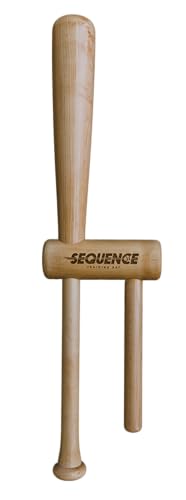
Sequence Junior Baseball & Softball Training Bat | Maple
- ✓ Instant feedback
- ✓ Easy two-hand sequencing
- ✓ Durable maple build
- ✕ Not for fast pitches
- ✕ Limited distance use
| Material | Premium maple hardwood |
| Recommended Age Range | Ages 7-11 |
| Weight Range | 31 oz – 36 oz |
| Length | 6 1/4 inches x 25 1/2 inches (overall dimensions) |
| Intended Use / Pitch Speed Limitation | Not intended for pitches over 40 mph; pitching distances beyond 25 feet |
| Special Features | Hands-separation design for sequencing and swing path; real-time feedback technology for hand placement and swing plane |
You know that moment when a training tool finally makes you notice what your hands are doing? I got this Sequence Junior Training Bat in hand, and I loved seeing how the two-hand separation feels in real time.
The maple has a clean, dense feel, and you can hear a crisp tap when you point the barrel toward the target.
From the first swing, you notice the instant feedback—tiny nudge of the hands tells you if your swing path wants a touch more inside-out or a touch more level. It’s not loud, but it’s perceptible enough to shape your practice session without overthinking.
It turns training into simple, repeatable checks you can act on right away.
The design really shines for younger athletes. The length and weight feel approachable for ages 7-11, and the 6 ¼” x 25 ½” footprint sits nicely in a tee setup or soft toss.
I enjoyed how the hands naturally separate, making you focus on sequencing without getting tangled in swing chaos.
Setups like tee work or side toss become more meaningful when you can see your path improve with each rep. The tool stays stable in a small footprint, which helps you lock in stance and barrel control during the drill rather than chasing movement after a miscue.
It’s sturdy enough to handle repeated sessions without feeling fragile.
Real-world use? It’s perfect for on-deck warm-ups and early swing rhythm work before the actual bat comes into play.
You’ll appreciate the safety: no pitching distances beyond 25 feet, and it’s clearly built to be a learning aid rather than a toy. If you’re after clearer hand movement and better swing plane for young players, this maple trainer earns its keep.
Overall, it delivers a focused, kid-friendly experience that translates to more confident, repeatable swings during practice and at-bats. The feedback loop is the standout, turning every rep into progress you can feel and hear.
SKLZ Pitch Training Baseball with Finger Markers, White 1

- ✓ Clear finger markers
- ✓ Quick grip guidance
- ✓ Official size/weight
- ✕ Marker wear over time
- ✕ Limited to training sequences
| Ball Type | Official size and weight baseball |
| Pitch Grip Markers | Finger placement markers for 4-seam fastball, 2-seam fastball, curveball, slider |
| Marker Printing | Finger placement markers printed on ball; color coded pitching key |
| Left/Right Hand Use | Supports both right- and left-handed pitchers |
| Training Focus | Grip guidance for specific pitches to improve throwing mechanics |
| Brand/Model | SKLZ Pitch Training Baseball with Finger Markers |
You’re holding a baseball that pretends to be a quick coach in your glove. I noticed the finger markers right away, tiny color spots that actually nudge you toward the correct grip without digging through notes.
First throw with the 4-seam marker felt surprisingly natural, almost like it was guiding your fingers into the right place as you lifted off the mound. The color-coded key on the ball is handy, so you’re not guessing which grip to use mid-session.
Switching to the 2-seam, you’ll feel a subtle shift in how the ball sits in your hand, and the markers give you that instant reassurance you’re aligned for the cut. For curve and slider, the markers aren’t just decorative; they’re a quick visual cue that helps you avoid over-rotating the wrist after a long bullpen.
It’s an official size and weight, which matters when you’re trying to replicate game-day feel in practice. You’ll notice the balance remains familiar, so you don’t get thrown off by a training ball that doesn’t resemble what you’ll throw in a real game.
What surprised me is how easy it is to flip between grips on the fly during dry reps. You can keep one hand on the ball and switch the grip markers with minimal fuss, which is perfect for a focused sequence session.
Put simply, this ball makes grip practice feel purposeful rather than puzzling. It’s a small tool, but it removes a lot of guesswork during pitch sequence training.
If you’re chasing more consistent grips without slowing down your session, this puck-sized coach in a ball is a solid companion.
What Is the Best Pitch Sequence in Baseball for Different Situations?
Solutions to mastering pitch sequences include extensive practice, studying opponents, and utilizing technology such as PitchFX and TrackMan to analyze pitch effectiveness. By implementing these strategies, pitchers can refine their approach, leading to more strategic decision-making on the mound and ultimately contributing to their team’s success.
How Does a Pitcher’s Strategy Affect Their Pitch Sequences?
A pitcher’s strategy significantly influences their pitch sequences, affecting the effectiveness of their performance and the outcome of the game.
- Understanding the Batter: A pitcher’s strategy often begins with analyzing the weaknesses and strengths of the opposing batter. By identifying pitch types that the batter struggles against, the pitcher can create a sequence designed to exploit these weaknesses, increasing the chances of a successful outcome.
- Mixing Pitch Types: Incorporating a variety of pitch types, such as fastballs, curves, and sliders, can keep batters off-balance. A well-thought-out sequence that alternates between different pitches can prevent hitters from timing their swings, making it difficult for them to make solid contact.
- Setting Up Pitches: The strategy of “setting up” pitches involves using certain pitches to pave the way for more effective ones later in the sequence. For instance, a pitcher might start with a fastball to establish speed before following up with a breaking ball, which can appear similar in trajectory but ultimately diverges, leading to swings and misses.
- Game Situation Awareness: A pitcher’s approach will vary depending on the game situation, such as the score, inning, and the number of outs. For example, with runners on base, a pitcher may opt for more aggressive pitches to induce quick outs rather than risk allowing base hits, which can adjust their sequence accordingly.
- Utilizing Pitch Location: The location of each pitch plays a crucial role in the overall strategy. By varying pitch locations—high, low, inside, and outside—a pitcher can create uncertainty for the batter, making it harder for them to anticipate the next pitch and leading to mistakes.
- Adapting to Feedback: Pitchers must be adaptable based on immediate feedback from the game, such as the effectiveness of particular pitches and the batter’s reactions. If a certain pitch type is consistently being hit well, the pitcher may need to adjust their sequence to avoid that pitch, ensuring they stay unpredictable.
What Pitch Types Should Be Included in an Effective Sequence?
An effective pitch sequence in baseball typically includes a variety of pitch types to keep batters guessing and optimize the pitcher’s performance.
- Fastball: The fastball is the most fundamental pitch type, known for its speed and straight trajectory. It sets the tone for the at-bat, allowing pitchers to establish the strike zone and gauge a batter’s timing.
- Breaking Ball: This includes pitches like the curveball and slider, which have significant movement. Breaking balls can disrupt a batter’s swing timing and create opportunities for strikeouts, especially when used after a fastball.
- Changeup: The changeup is a slower pitch that appears similar to a fastball in terms of delivery but arrives at the plate with reduced speed. This pitch is effective for keeping hitters off balance and can induce weak contact or swings and misses if executed properly.
- Sinker: The sinker is designed to drop as it approaches the plate, making it difficult for batters to lift the ball. It is particularly useful for inducing ground balls and is often employed in situations where a double play is desired.
- Splitter: The splitter is a pitch that drops sharply as it nears the plate, giving it a similar look to a fastball before diving down. This pitch can be very effective against batters who are overly aggressive, often resulting in swings and misses.
Why Is Understanding Batter Preferences Crucial for Pitch Sequencing?
Understanding batter preferences is crucial for pitch sequencing because it enables pitchers to tailor their strategy effectively, increasing the likelihood of success in each at-bat.
According to a study published in the Journal of Sports Sciences, knowledge of a batter’s historical performance against certain pitch types significantly enhances a pitcher’s ability to make informed decisions during gameplay (Lentz et al., 2020). This understanding allows pitchers to exploit weaknesses and maximize their effectiveness against specific batters.
The underlying mechanism involves the interaction between a batter’s cognitive processing and physical response to different pitches. Batters develop preferences based on their experiences, which influence their reaction times and ability to make contact. For instance, a batter may struggle against breaking balls but excel with fastballs, leading pitchers to adjust their sequences accordingly. This strategic adaptation not only increases the pitcher’s chances of striking out the batter but also alters the batter’s mental approach, potentially leading to further advantages in subsequent at-bats.
Additionally, research from Sports Analytics Journal indicates that the predictability of a pitch sequence can significantly affect a batter’s performance. When pitchers successfully exploit known batter preferences, they can introduce a level of uncertainty that disrupts the batter’s timing and rhythm. Thus, a nuanced understanding of these preferences is critical for developing the best pitch sequence in baseball, directly impacting game outcomes.
How Can Pitchers Adjust Their Sequences Based on Batter Weaknesses?
Pitchers can adjust their sequences based on batter weaknesses by employing various strategies that exploit the specific tendencies of each batter.
- Analyzing Batter Swing Patterns: Pitchers can observe and analyze the swing patterns of batters in previous games to identify their weaknesses, such as which pitches they struggle to hit. By focusing on these weaknesses, pitchers can sequence their pitches to start with those that exploit the batter’s vulnerabilities, increasing their chances of success.
- Utilizing Pitch Types: Different pitch types can be used strategically to confuse or disrupt a batter’s timing. For instance, if a batter has difficulty with breaking balls, a pitcher might start with fastballs to establish speed before introducing curveballs or sliders to catch the batter off-guard.
- Changing Locations: Adjusting the location of pitches can be crucial in keeping batters guessing. By pitching inside and then moving outside, or vice versa, pitchers can exploit a batter’s inability to adjust to pitch location, leading to poor contact or missed swings.
- Incorporating Pitch Counts and Game Situations: Understanding the context of the game, such as the count and the presence of runners, allows pitchers to tailor their sequences strategically. For example, with two strikes, a pitcher might opt for a more deceptive pitch that the batter may chase due to their aggressive tendencies in such situations.
- Utilizing Data and Technology: Advanced analytics and technology, such as video analysis and data tracking systems, can provide pitchers with detailed insights into batter tendencies and weaknesses. This information can guide pitchers in crafting their sequences, ensuring they are not only effective but also tailored to the specific matchup.
What Are Some Proven Examples of Winning Pitch Sequences Used by Professionals?
Some proven examples of winning pitch sequences used by professionals include:
- Fastball-Changeup: This classic combination is effective because it disrupts the hitter’s timing. The fastball establishes speed and location, while the changeup, which is thrown with the same arm motion, significantly slows down the pitch, often resulting in weak contact or swings and misses.
- Breaking Ball-High Fastball: Starting with a breaking ball, such as a curveball or slider, can induce a swing from a hitter expecting a slower pitch. Following it up with a high fastball takes advantage of the hitter’s adjusted timing and can lead to a strikeout or a pop-up.
- Inside Fastball-Outside Slider: This sequence is designed to create confusion in the batter’s mind. An inside fastball forces the hitter to adjust his stance, and then an outside slider can catch them off-guard, leading to weak contact or a miss, especially if the hitter is trying to pull the ball.
- Two-Seam Fastball-Sinker: The two-seam fastball is known for its movement, while a sinker can induce ground balls. By mixing these pitches, pitchers can keep hitters guessing and can exploit weaknesses, especially with groundball-prone batters, leading to double plays.
- Changeup-High Fastball: Starting off with a changeup can make hitters overcommit early in their swings. Following up with a high fastball takes advantage of their adjusted timing from the slower pitch, often resulting in swings that miss the strike zone or pop-ups.
How Can Pitchers Continuously Improve Their Sequencing Techniques?
Pitchers can continuously improve their sequencing techniques by focusing on various strategies and areas of development.
- Understanding Opponent Tendencies: Analyzing the batting patterns and weaknesses of opponents allows pitchers to tailor their sequences effectively. By studying data and scouting reports, pitchers can identify which pitches tend to be more successful against specific hitters, enhancing their game strategy.
- Utilizing Pitch Mix: Developing a diverse pitch mix is crucial for keeping hitters off balance. By effectively mixing fastballs, breaking balls, and changeups, pitchers can create uncertainty and force hitters to adjust, which increases the chances of success.
- In-Game Adjustments: The ability to make real-time adjustments during a game is essential for a pitcher’s success. Observing how hitters respond to certain pitches allows pitchers to refine their sequences on the fly, opting for different pitches or locations that exploit the current situation.
- Feedback from Coaches and Catchers: Collaborating with coaches and catchers provides invaluable insights into pitch selection and sequencing. Catchers, in particular, can offer immediate feedback based on their perspective and experience, enabling pitchers to learn and adapt their strategies efficiently.
- Video Analysis: Reviewing game footage can help pitchers identify patterns in their sequencing and pinpoint areas for improvement. By analyzing their own performance and that of successful peers, pitchers can gain insights into effective approaches and make necessary adjustments.
- Practicing with Simulated Scenarios: Engaging in practice sessions that simulate game situations can enhance a pitcher’s ability to sequence pitches. This method allows pitchers to experiment with different sequences and develop a feel for what works best against various types of hitters.
- Mental Preparation and Visualization: Fostering a strong mental approach through visualization techniques can improve a pitcher’s confidence and execution. By mentally rehearsing pitch sequences and outcomes, pitchers can enhance their focus and decision-making during actual games.