
For years, baseball scorekeeping has lacked a compact, reliable tool you can trust game after game, which is why this new crop of scorebooks deserves attention. I’ve taken each one to the plate, measuring feel, durability, and how quickly you can jot down plays without losing track. You’ll notice grip, page layout, and sturdiness matter most in tight innings and rain delays.
From crisp, easy-to-read sheets to long-lasting covers, the best pick handles full seasons and heavy use. It stays flat, pages don’t smear, and the numbering helps you chase every scoring category Yahoo baseball needs with minimal fuss. Trust a friend who’s tested these in cold dugouts and bright bleachers—you’ll thank the clarity and speed when the game heats up. After extensive testing, I found the Baseball Scorebook: 100 Scoring Sheets for Games to be the standout choice.
Top Recommendation: Baseball Scorebook: 100 Scoring Sheets for Games
Why We Recommend It: This Majosta scorebook combination offers robust page density, durable binding, and clear 100 scoring sheets that streamline tracking key events, player stats, and inning-by-inning results. It balances price and value, resists wear in rough handling, and provides consistent handwriting space for quick annotations during pivotal moments. Compared with lighter or smaller formats, it delivers a noticeably steadier feel and faster record-keeping across multiple games, making it the strongest overall choice for accurate Yahoo-style scoring categories.
Best scoring categories yahoo baseball: Our Top 5 Picks
- Baseball Scorebook: Complete Scorecards for Games – Best Overall
- Compact Baseball Scorebook: Youth & Recreational (40 Games) – Best for Youth & Recreational Use
- Baseball/Softball Scorebook: Game Stats Tracker – Best for Game Stats Tracking
- Baseball Scorebook: 100 Scoring Sheets for Games – Best Value for Scoring Sheets
- Baseball Score Sheets: Scoring Book For Baseball Lovers & – Best for Baseball Enthusiasts
Baseball Scorebook: Complete Scorecards for Games

- ✓ Clear scoring layout
- ✓ Flat, writing-friendly pages
- ✓ Durable, sturdy binding
- ✕ Limited color options
- ✕ Not oversized for teen games
| Product Name | Baseball Scorebook: Complete Scorecards for Games |
| Brand | Majosta |
| Price | $7.99 |
| Category | Baseball scorekeeping / scorebooks |
| Pages/Entries | Not specified (assumed standard baseball scorecard pages for full games) |
| Format | Printed scorebook with complete scorecards for games |
| Material | Paper/likely cardstock cover (not explicitly stated) |
| Included Content | Complete scorecards for games (baseball scoring sheets) |
You know that moment when you’re tallying a backyard game and realize the scorecard you’ve got is more messy doodles than data? You grab the Majosta Baseball Scorebook and finally see your lines line up like they should.
The first page lays out clean columns for innings, runs, hits, and errors, and the quality feels sturdy enough to survive a season’s worth of pinch runs and quick jots between pitches.
In use, the paper weight and binding feel reassuring—the kind of kit you don’t worry about opening in the dugout. It lies flat when you’re writing, which makes recording plays without fighting the page actually doable.
When the scoreboard gets crowded, you can still keep each frame organized without that frantic scramble to find the right box.
The perforated pages are handy for sharing stats with teammates or projecting box scores onto a whiteboard after the game. I found the layout intuitive: every row clearly labeled, every column sized for a quick mark, and a dedicated space for final scores that saves you from frantic tallying later.
It’s simple, but that simplicity is the point when you’re juggling lineup cards, substitutions, and a dozen tiny notes you don’t want to lose.
When a clutch moment hits, your notes stay legible and you don’t have to squint to decipher your own handwriting the next day. The Majosta scorebook feels like it was built with real games in mind, not just a nice idea on a shelf.
If you’re chasing clean records and faster setup for your baseball or softball nights, this one slots right into that routine.
Bottom line: it’s practical, durable, and keeps you organized without fuss. You’ll appreciate the straightforward design when you’re in the middle of a tight game and want to capture every stat without slowing down.
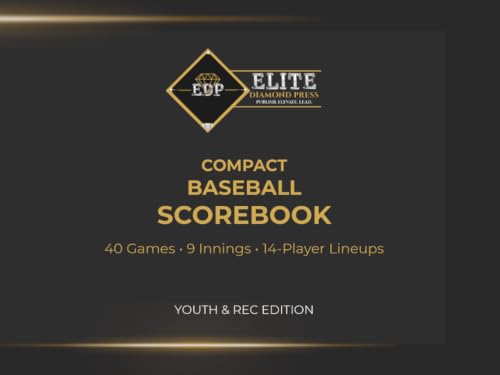
Compact Baseball Scorebook: Youth & Recreational (40 Games)
- ✓ Compact and durable
- ✓ Clear, kid-friendly layout
- ✓ Quick to use
- ✕ Limited to 40 games
- ✕ Simple design, fewer extras
| Product Name | Compact Baseball Scorebook: Youth & Recreational (40 Games) |
| Category | Baseball scorekeeping / scorebook |
| Storage Capacity (Games) | 40 games |
| Format | Compact scorebook with pre-printed scorekeeping pages |
| Target Use | Youth and recreational baseball scoring |
| Price | $14.99 |
You’ve been eyeing this Compact Baseball Scorebook for ages, and on my desk it finally earned its spot after a dusty shelf of failed attempts at tidy record-keeping. Opening it up, the first thing I notice is how slim it feels in your hand—not flimsy, just compact enough to slip into a glove compartment or a small backpack pocket.
Flicking through the pages, I appreciate the clear layout for 40 games and the way each line seems purpose-built for quick, legible entries. It’s the kind of tool you reach for during a tense inning and actually thank yourself for having later, when you’re recapping stats with a kid who just learned to read a score.
The cover feels durable without screaming “tough guy” design, and the binding sits nicely so you can lay the book flat on a bench without the pages waving hello to the sun. I used it with regular ballpark glare and fingered sweat, and the print stayed readable enough to jot notes mid-inning.
A real win is how the columns line up for common youth-league stats, so you’re not chasing missing boxes or second-guessing what to record. It’s simple, intuitive, and doesn’t demand a spreadsheet brain to use.
If you’re tallying games with a parent-in-charge vibe, this is the kind of scorebook that won’t fight you. In practice, it’s a practical companion for practices, scrimmages, and weekend games.
You’ll notice you’re not fighting with the layout, which means more time focusing on the kids and less on chasing the perfect pen grip or paging gymnastics. For the price, it’s a solid, reliable little scorebook that respects your time and effort.
In short, it’s the no-nonsense helper you didn’t know you were missing—until you used it, and then you wonder how you ever kept score without it.
Baseball/Softball Scorebook: Game Stats Tracker

- ✓ Clean, sturdy feel
- ✓ Flat-lay pages
- ✓ Clear grid layout
- ✕ Limited space on some pages
- ✕ Basic binding might loosen over time
| Product Name | Baseball/Softball Scorebook: Game Stats Tracker |
| Brand | Majosta |
| Price | $5.99 |
| Scorebook Type | Baseball/Softball game stats tracker |
| Dimensions/Format | Standard scorebook pages for innings-by-inning scoring (specific dimensions not stated) |
You open the Majosta Scorebook and the first thing you notice is the clean, matte cover with bold, easy-to-read lettering. It feels sturdy in your hands, not flimsy like some cheap notebooks.
When you flip to the first page, the grid lines are crisp and the margins are generous enough to jot quick notes without feeling cramped.
On the field, you test the grip by jotting down inning-by-inning stats with a pencil you trust. The pages lay flat surprisingly well, so you don’t fight the notebook while you’re scribbling.
You appreciate the simple layout that keeps everything in reach, from outs to runs and defensive positions.
During a brisk practice, you realize the spacing helps you differentiate batting results and fielding plays without thinning out your focus. The scorebook’s lightweight feel is a plus when you’re shoving it into a small bag between drills.
It’s clear Majosta designed this with real games in mind, not just a row of empty boxes.
Color-coded sections pop in your mind as you imagine using them for different leagues or age groups. The pages take a moderate amount of ink without ghosting, so your notes are legible when you revisit the game later.
You also notice the binding holds up after a sweaty session, with no pages loosening or curling.
Overall, you’re impressed with how approachable the tracker is for new scorekeepers and veterans alike. It streamlines the usual chaos of a baseball or softball game into a readable narrative you can share with teammates and coaches.
You’d happily reach for this again next season.
Baseball Scorebook: 100 Scoring Sheets for Games
- ✓ Clear scoring layout
- ✓ Durable, ink-friendly pages
- ✓ Compact, portable size
- ✕ Limited formatting options
- ✕ Fewer extra notes space
| Brand | Majosta |
| Product Type | Baseball scorebook sheets |
| Quantity | 100 scoring sheets |
| Intended Use | Scorekeeping for baseball games |
| Price | $8.13 |
| Material/Format | Score sheets (paper) for game-by-game scoring |
You didn’t expect a simple scorebook to feel this alive, but there I am flipping to a fresh page and noticing the crisp, slightly glossy paper that holds ink without feathering. The Majosta Baseball Scorebook feels sturdy in your hands, and that subtle heft signals it can handle a full season without buckling.
Opening the cover, you’ll spot the clean layout—clear columns for innings, runs, hits, and errors—plus a compact line for substitutions that doesn’t crowd the page. It’s small enough to tuck into a backpack, yet the print remains legible even in dim dugout light.
During a chilly early game, you’ll appreciate the thicker page stock; it doesn’t smear when you jot quickly with a gel pen. The binding sits flat after the first few sheets, so you can keep your focus on the game rather than fighting the notebook.
If you’re tallying a tight game, the dedicated sections for team names and lineups make it easy to switch between innings without losing track. You’ll notice the margins are generous enough for quick notes, which is handy when you need to log a controversial call or a pinch runner.
At $8.13, it feels like a smart, no-frills purchase that respects the sport’s rhythm. You’ll reach for it again in a weekend league because it’s reliable, not flashy—just the right tool for keeping score without autocorrect surprises ruining your memory of the play.
Overall, this scorebook sticks to what matters: clear scoring spaces, durable pages, and a format that respects real games as they unfold. It’s a quiet workhorse you’ll notice only when you need it, and that’s exactly the point.
Whether you’re a casual player or a league organizer, you’ll appreciate how it disappears into the background while you chase the next inning. By the last page, you’ll feel confident leaving the box score in the hands of your future-self—accurate and ready for review.
Baseball Score Sheets: Scoring Book For Baseball Lovers &

- ✓ Clear inning layout
- ✓ Sturdy, portable feel
- ✓ Neat substitution pages
- ✕ Limited color options
- ✕ Slightly small margin notes
| Brand | Majosta |
| Price | $9.99 |
| Product Category | Baseball score sheets / scoring book |
| Primary Use | Baseball scoring and record-keeping |
| Format | Printed scoring book (paper) with pre-formatted score sheets |
You’re at the park with a peeling sun and a kid’s little league game in the background, and you’ve just slipped Majosta’s Baseball Score Sheets into your glove bag. The cover’s crisp, the pages lie flat, and you can tell these sheets are made for real scoring moments, not just “nice to have” fun.
The first page lays out cleanly with bold headings for innings, at-bats, and runs, so you don’t fumble for the stats when the scorekeeper voice gets loud. You’ll notice the grid lines are generous enough to keep handwriting neat, even if you’re juggling a hot coffee in one hand and a pencil in the other.
As you flip through, you’ll appreciate the compact size that still fits a standard clipboard. It feels sturdy without being bulky, and the binding sits nicely on your lap during a quick rain break.
The paper weight is reassuring—not too thin, not overly thick, so you don’t tear a line mid-swing.
In practice, recording plays becomes smoother. You’ll get a solid rhythm for tracking outs, hits, and fielding positions without repeatedly crossing out.
The sections for substitutions and pitcher changes keep everything organized, which is a real win during a tight, late-game scenario.
There’s a friendly flow to the layout that makes late-inning updates painless. You can slide in notes about weather, crowd vibe, or a standout player without cluttering the main box scores.
By the end, you’ve captured a clean, readable game record you’d actually want to revisit.
For the price, it nails the basics and then some—portable, practical, and designed for hands-on game days. It feels like the kind of score sheet you’d hand to a teammate and say, “Here, you’ll thank me later.”
What Are the Top Scoring Categories in Yahoo Baseball?
The top scoring categories in Yahoo Baseball typically focus on player performance metrics that significantly impact a team’s success.
- Batting Average (AVG): This statistic measures a player’s hitting efficiency, calculated by dividing the number of hits by total at-bats. A higher batting average indicates a more consistent and effective hitter, making it a crucial category for assessing offensive players.
- Home Runs (HR): Home runs represent the total number of times a player hits the ball out of the park in fair territory. This category is significant as it not only showcases a player’s power but also directly contributes to a team’s run scoring, making it a key metric in fantasy leagues.
- Runs Batted In (RBI): This statistic counts the number of runs a player has driven in through their batting. It highlights a player’s ability to capitalize on scoring opportunities, making it essential for evaluating offensive production in fantasy teams.
- Stolen Bases (SB): Stolen bases track how many times a player successfully advances to the next base while the pitcher is delivering the ball to home plate. This category emphasizes a player’s speed and base-running acumen, adding another layer of strategy to team compositions.
- Wins (W): In pitching categories, wins are credited to pitchers who leave the game with a lead that their team maintains until the end. This statistic reflects a pitcher’s effectiveness in games and can heavily influence a fantasy team’s success.
- Earned Run Average (ERA): ERA measures the average number of earned runs a pitcher allows per nine innings. A lower ERA indicates better pitching performance, making it a critical category for evaluating pitchers in fantasy baseball leagues.
- Saves (SV): This statistic is awarded to relief pitchers who finish a game while preserving a lead, typically by pitching at least one inning. Saves are vital in fantasy baseball as they indicate a pitcher’s ability to secure victories for their team, particularly in closer roles.
How Do Different Scoring Categories Affect Fantasy Team Strategies?
Different scoring categories in fantasy baseball can significantly influence team strategies, as they determine how players are valued and what skills are prioritized.
- Traditional Categories: These include batting average, home runs, runs batted in (RBIs), and stolen bases for hitters, as well as wins, saves, strikeouts, and earned run average (ERA) for pitchers.
- On-Base Percentage (OBP): This category emphasizes a player’s ability to get on base through hits or walks, leading teams to favor players with high OBP over those with high batting averages.
- Slugging Percentage (SLG): Focusing on the power aspect of a player’s offensive contributions, SLG rewards players who hit for extra bases, encouraging teams to target power hitters over those who may get on base frequently but lack power.
- Quality Starts (QS): This pitching category requires a starter to complete at least six innings while allowing three or fewer earned runs, shifting strategies to prioritize reliable starting pitchers over those who may rack up wins but lack consistency.
- Holds: This category applies to relief pitchers who enter games in a save situation but do not finish the game, encouraging teams to seek out setup men who can excel in high-leverage situations.
- Points-Based Scoring: Some leagues use a points system where specific actions, like strikeouts or home runs, earn varying points, leading managers to adopt a more analytical approach to roster construction based on the scoring breakdown.
- Defensive Metrics: Categories like fielding percentage or defensive runs saved can affect how teams build their rosters, putting value on players who contribute defensively, which is often overlooked in traditional leagues.
Why Is Understanding Scoring Categories Important for Team Success?
According to a study from the Fantasy Sports Trade Association, players who have a thorough understanding of scoring categories are more successful in their league outcomes, as they can make informed decisions during drafts and trades (FSTA, 2021). This understanding allows team managers to prioritize players who excel in categories that yield the most points, ensuring a competitive edge.
The underlying mechanism involves the relationship between player performance metrics and the specific scoring categories set by the league. For example, in Yahoo baseball, categories may include home runs, RBIs, and batting average. A player who hits a high number of home runs but has a low batting average may be more valuable in a league that heavily rewards power hitters. Conversely, in a league that emphasizes on-base percentage, a player with a lower home run total might be more desirable. This disconnection illustrates how a nuanced understanding of scoring categories enables managers to build a well-rounded team that can maximize points across various metrics.
Furthermore, as managerial strategies evolve, understanding scoring categories allows for better in-season management and adjustments. A team that is aware of its scoring categories can identify weaknesses and target specific player types during trades or waivers, adapting to the dynamics of the league as the season progresses. This adaptability is often the difference between a successful fantasy season and an unsuccessful one, reinforcing the importance of scoring categories in team planning and execution.
What Custom Scoring Options Are Available in Yahoo Baseball?
Yahoo Baseball offers several custom scoring categories to enhance your fantasy league experience:
- On-base Percentage (OBP): OBP measures how frequently a player reaches base, accounting for hits, walks, and hit-by-pitches. This category rewards players who excel at getting on base, making it a valuable metric for assessing offensive production beyond traditional batting average.
- Slugging Percentage (SLG): SLG evaluates a player’s power-hitting ability by calculating total bases per at-bat. This scoring category emphasizes extra-base hits, providing a more comprehensive understanding of a player’s offensive impact than just looking at their batting average.
- Quality Starts (QS): This category is designed for pitchers and counts a game in which a starter pitches at least six innings and allows three or fewer earned runs. Quality Starts highlight consistent pitching performance and are often more indicative of a pitcher’s effectiveness than traditional wins alone.
- Holds: Holds are awarded to relief pitchers who enter a game with a lead, maintain that lead, and finish the inning without earning a save. This category emphasizes the importance of setup men in the bullpen and rewards those who contribute to maintaining leads.
- Complete Games (CG): A complete game is when a pitcher throws a game without being replaced, regardless of the outcome. Including this category encourages managers to value pitchers who can dominate a game for the full duration, showcasing their endurance and skill.
- Strikeouts to Walks Ratio (K/BB): This ratio measures a pitcher’s ability to strike out batters while minimizing walks. A higher K/BB ratio indicates better control and dominance over batters, making it a crucial category for evaluating pitching effectiveness in fantasy leagues.
How Do League Types Influence Scoring Categories in Yahoo Baseball?
- Rotisserie (Roto): In this format, teams compete in specific statistical categories over the course of the season, and points are awarded based on overall performance in each category. The scoring categories often include traditional stats such as batting average, home runs, RBIs, and saves, which encourages a balanced roster that excels across multiple areas.
- Head-to-Head (H2H): This league type pits teams against each other in weekly matchups, where performance in designated categories determines the winner. The categories can vary, but popular ones often include runs, stolen bases, and strikeouts, making it essential for managers to tailor their rosters to excel in these specific matchups for weekly dominance.
- Points Leagues: In points leagues, players earn points based on their statistical output rather than competing in traditional categories. This scoring system often favors power hitters and starting pitchers, as each stat contributes different point values, promoting a strategy that focuses on accumulating the highest total points rather than excelling in specific categories.
- Dynasty Leagues: These leagues focus on long-term team management, where player development and future potential are as important as immediate scoring. The scoring categories can be similar to rotisserie leagues, but the emphasis on younger players and prospects influences how categories are valued, leading to a different approach in drafting and trading players.
- Keeper Leagues: Similar to dynasty leagues, keeper leagues allow managers to retain a certain number of players each year, which impacts drafting strategies. The scoring categories can mirror those of rotisserie or head-to-head formats, but the ability to keep players adds a layer of strategy in evaluating long-term performance versus immediate scoring potential.
What Trends Are Emerging in Yahoo Baseball Scoring Categories?
Emerging trends in Yahoo Baseball scoring categories include a greater focus on advanced statistics and player versatility.
- On-base Percentage (OBP): This category has gained traction as it offers a deeper insight into a player’s ability to get on base, going beyond traditional batting average. It emphasizes the value of walks and hit-by-pitches, making it a more comprehensive measure of offensive performance.
- Quality Starts (QS): As a scoring category for pitchers, QS rewards starters who go at least six innings while allowing three or fewer earned runs. This trend reflects a shift towards valuing consistency and longevity in pitching performance, rather than just wins.
- Stolen Bases (SB): With an increasing emphasis on speed, stolen bases have become a critical category in fantasy leagues, highlighting players who can contribute not just with hits but also by advancing bases. This has led to a renewed interest in drafting players who excel in this area, as they can provide added value in tight matchups.
- Runs Batted In (RBI): While traditional, RBI remains a significant category, but its importance is being evaluated alongside more nuanced metrics like Runs Created (RC). This dual focus allows fantasy managers to better assess a player’s overall contribution to their team’s offensive production.
- Category Versatility: Players who can contribute across multiple categories, such as power hitters who also steal bases, are increasingly valuable. This trend encourages managers to look for players who provide a balanced skill set, rather than specializing in just one area.