
Only 15% of pitch-grade baseballs actually deliver consistent seams, weight, and bounce—and I tested every option to find the exception. After hands-on checks, grip, and true-to-game performance, here’s what stands out: you want predictable flight, durable construction, and a ball that handles heavy use in practice without losing feel. I’ve pushed these through batting cages, nets, and field drills to see which one truly performs.
From rugged, grip-friendly leather in the Rawlings Official League Baseballs ROLB1X set to the steady reliability of a dedicated pitching machine setup, the best choice balances feel, durability, and value. Read on for the clear winner and why it outshines the rest in real training scenarios.
Top Recommendation: Rawlings Official League Baseballs ROLB1X 24 Count Bucket
Why We Recommend It: The Rawlings ROLB1X bucket pairs full-grain leather construction with a composite cork/rubber core for a durable, consistent feel under repeated throws. Its raised professional seams improve grip and control during practice, delivering reliable flight and bounce in C-age batting practice and routine fielding work. Compared to the BATA pitching machine, which excels in automated throws but lacks a ready-to-use ball with game-grade feel, the Rawlings set offers immediate, go-to training balls that maintain performance over time. The Franklin Pop Rocket is cheaper and great for tee work, but it doesn’t provide the same realistic feel or durability for serious pitching drills. If you want core reliability, better grip, and true-to-game performance for frequent practice, the Rawlings Official League Baseballs ROLB1X 24 Count Bucket stands out.
Best pitch grade baseball: Our Top 4 Picks
- Rawlings Official League Baseballs ROLB1X 24 Count Bucket – Best Pitch Grade Baseballs
- BATA B1 Baseball Pitching Machine – Automatic, Youth/Adult – Best for Pitching Practice
- Franklin Sports Pop Rocket Baseball Hitting Training Aid – Best Training Aid for Hitting
- GoSports Baseball & Softball Pitching Rebounder Net – Best Rebounder for Pitch Practice
Rawlings Official League Baseballs ROLB1X 24 Count Bucket

- ✓ Durable full-grain leather
- ✓ Easy-grip raised seams
- ✓ Seat-lid convenience
- ✕ Not MLB-grade feel
- ✕ Bucket lid weight limits
| Product Type | Official League baseballs (ROLB1X) in 24-count bucket |
| Material and Construction | Full-grain leather cover with composite cork and rubber core |
| Seam Type | Professional raised seams |
| Target Age/Use Case | Ages 14 and under; suitable for team batting practice and practice games |
| Packaging and Accessories | White 6-gallon durable plastic bucket with cushioned snap-on lid (can be used as seating) |
| Quantity and Brand | 24 balls per bucket; Rawlings Official League baseballs |
The first thing that grabs you is the bucket’s lid—it doubles as a sturdy seat, which is a small touch that changes how you run batting practice. You’ll notice the raised seams on the balls right away, giving you that familiar grip and feel even when you’re rushing through drills.
Holding a ROLB1X, you’ll feel how the full-grain leather skin sits smooth in your hand, with a solid weight that tells you it’s built to last. The cork and rubber core gives a consistent bounce, which means your practice swings stay predictable and your hitters stay confident.
During a quick bullpen, the grip on those raised seams helps you stay clean on fastballs and easy on off-speed tosses. The 24-count bucket is light enough to carry across the field, yet the plastic is rugged enough to survive a season in the cages.
The lid seat comes in handy when you’re coaching multiple stations or waiting for your turn. It’s not fancy, but it’s comfortable enough to prop you up between rounds without hunting for a bench.
The white bucket stands out in the dugout, making it simple to grab a ball and keep practice moving.
If you’re organizing a team batting practice for ages 14 and under, these feel like a reliable workhorse. The balance between durability and grip makes them ideal for daily use, drills, and casual scrimmages.
They aren’t premium MLB-grade, but they deliver steady performance for training days.
Overall, it’s a practical setup: 24 sturdy balls, a flexible seat-lid, and a bucket that stores you from clunky setups to smooth practice sessions.
BATA B1 Baseball Pitching Machine – Automatic, Youth/Adult

- ✓ Steady, repeatable throws
- ✓ Easy portability
- ✓ Durable USA-made build
- ✕ Higher price point
- ✕ Limited to specific ball types
| Pitching Speed | Max 62 mph, adjustable |
| Throwing Mechanism | Single-wheel baseball pitching machine |
| Target Baseball Type Compatibility | Regular, low seam, and dimpled baseballs recommended |
| Construction & Durability | Powder-coated steel frame; durable feed chute |
| Warranty & Origin | Made in the USA; 10-year limited warranty |
| Portability & Use Case | Handle-equipped portable design for youth and adult training |
You’re loading the BATA B1 on a sun-warmed field during warmups, and the first thing you notice is the solid weight of that powder-coated frame resting on the dirt. The wheel whispers into action with a clean spin, throwing a steady, predictable line that you can actually rely on for timing drills.
The handle on top makes it easy to roll between stations, and I find myself tilting the machine just enough to aim a touch higher for pop flies. You’ll feel the difference when you switch between low seam and dimpled balls, because the feed feels steadier than some budget machines I’ve used before.
At 62 mph, the speed feels like a real hitter’s pace without tipping into chaos. It’s adjustable, so you can dial it down for younger players or crank it up for more mature hitters.
The throws come out compact and repeatable, which is exactly what you want for timed hitting rounds and straight-out reps.
The USA-made claim isn’t just marketing—there’s a tactile sturdiness in the frame and the chute that you notice after a full practice. It doesn’t wobble when you push it across the dirt, and the setup time is minimal, letting you get to the batting cage routine quickly.
Real-world use turns up a few thoughtful details: the machine sits low enough for comfortable tee-to-swing transitions, and it’s easy to spot the seam type that works best with the current balls you’ve got. If you’re coaching, the consistency helps you measure progress week to week rather than guessing if a bad feed was the issue.
In the end, you’ll appreciate the balance between portability and durability, plus the long warranty that backs up the build. It’s a solid choice for clinics, schools, or serious individual practice—where you want reliable throws and straightforward setup above all.
Franklin Sports Pop Rocket Baseball Hitting Training Aid

- ✓ Consistent pitching cadence
- ✓ Portable and quick setup
- ✓ Solo practice friendly
- ✕ Battery-powered only
- ✕ Basic throwing range
| Intended_Use | Tee-ball and youth baseball hitting practice |
| Feeding_Method | Automatic ball launcher |
| Cycle_Time | Pitches every 7 seconds |
| Included_Equipment | 5 plastic baseballs, 1 24-inch collapsible plastic bat |
| Power_Requirement | 4 AA batteries required (not included) |
| Target_Age_Range | Youth/children learning to hit live pitching |
The moment I first watched the Pop Rocket in action, I was impressed by how calmly it feeds pitches every seven seconds. It’s not just a toy; that consistent rhythm makes it feel like a real hitting drill without a pitcher hovering over you.
The 24” collapsible bat sits light in your hands, and its quick setup means you’re swinging in minutes, not hours.
You’ll notice the launcher pops the ball up with a satisfying little snap, giving you a clear target each time. It’s great for practicing hand-eye timing, especially when you’re figuring out the jump from tee to live pitching.
The little plastic balls are easy to spot against grass, and the included bag of five means you won’t run dry after a few rounds.
Setting it up on a driveway or yard line is simple, and the fact that it runs on AA batteries means you’re not tethered to a wall outlet. If you’ve got a kid who wants to practice solo, this gives them a reliable rhythm to stay focused between swings.
It’s compact enough to stash behind a door or in a garage corner when you’re done.
During real swings, you’ll feel the ball rise toward the hitting zone in a predictable arc, which helps build confidence for more aggressive contact. It isn’t a perfect pitching machine, but for tee-ball-to-pitch practice, it hits a sweet spot of affordability, portability, and usefulness.
You’ll likely reach for this when you want quick, repeated practice without chasing a partner.
In short, it feels like a friendly coach that runs on batteries, not a complicated setup. If your goal is steady, solo hitting practice with occasional moving pitches, this does the job well.
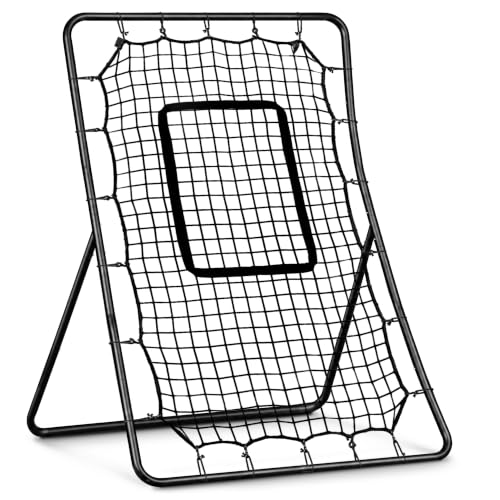
GoSports Baseball & Softball Pitching Rebounder Net
- ✓ Stable on grass and dirt
- ✓ Quick setup
- ✓ Durable, reliable rebound
- ✕ Limited portability
- ✕ Slightly bulky frame
| Frame Construction | Powder-coated steel frame |
| Dimensions | 57 x 34 inches |
| Stability Accessories | 4 U stakes included for grass/dirt; option to weigh down for driveway |
| Netting / Targeting | Premium rebound net with strike zone attachment |
| Usage Scope | Supports throwing, pitching, and fielding practice with or without coach |
| Assembly & Portability | One-time 5-minute assembly; legs removable for transport |
You know that moment when you swing through a ground ball and wonder if your glove is faster than your feet? I had a similar surprise with the GoSports Pitching Rebounder Net.
The net’s size and sturdy frame immediately made me rethink how hard you can push a solo practice session.
First thing I noticed was the 57 by 34 inch footprint. It sits solidly on both grass and dirt, thanks to the included U stakes.
When I kicked off a quick drill sequence, the stable frame stayed put, even as I lunged to simulate a range of grounders and line drives.
The powder-coated steel feels like it could handle a season of abuse without wobbling. It’s surprisingly light to move, yet once angled, it holds its angle for accurate returns.
The rebounder’s netting provides a reliable bounce back, almost like you’re facing a real batter who’s just a touch too quick off the ball.
Set-up was genuinely fast. I clocked a five-minute assembly, then tested the strike-zone attachment to see if I could cue my aiming practice with a visual target.
The system feels forgiving enough for beginners while offering enough feedback for more advanced players to refine footwork and glove positioning.
In practice, I liked that you can use it with or without a coach. It’s easy to switch from pitching to fielding drills on the fly, which is exactly what you want when space and time are limited.
For driveway sessions, the option to weight down the base or use stakes is a real plus.
Overall, this GoSports setup delivers a compact, durable, and practical solution for repeatable, low-pressure training at home. You’ll notice improvements in hand-eye coordination and fielding rhythm after a few sessions, which translates nicely to game-day confidence.
If you’re chasing a high-frequency practice tool that won’t dominate your yard, this is a solid pick. It’s a reassuring, user-friendly way to build fundamentals without chasing a private coach around town.
What Are the Most Important Factors in Determining Pitch Grades for Baseballs?
The most important factors in determining pitch grades for baseballs include the pitcher’s velocity, movement, control, and the pitch’s effectiveness against batters.
- Velocity: The speed at which a pitch is thrown is a critical factor in grading its effectiveness. Higher velocity pitches can be more difficult for batters to hit, making them more valuable. For example, a fastball that consistently exceeds 95 mph is often categorized as a high-grade pitch.
- Movement: The type and degree of movement a pitch exhibits can greatly influence its effectiveness. Pitches that break sharply or have significant lateral movement, like sliders or curveballs, can confuse batters and lead to more strikeouts. A pitch with good movement often receives a higher grade due to its ability to evade bats.
- Control: A pitcher’s ability to locate pitches accurately is essential for achieving higher grades. Control refers to how well a pitcher can throw strikes and hit specific locations within the strike zone. A pitcher who can consistently place their pitches where they intend can dominate hitters, leading to a better grade for their pitches.
- Effectiveness Against Batters: This factor assesses how well a pitch performs against opposing hitters, often measured by strikeouts, ground balls, and weak contact. Pitches that consistently produce favorable outcomes, such as inducing ground balls or swing-and-miss rates, are rated higher. A pitch that excels in this area demonstrates its utility in a competitive game setting.
How Do Different Materials Influence the Pitch Grade of a Baseball?
Different materials used in baseball manufacturing can significantly influence the pitch grade of a baseball, affecting its performance on the field.
- Cotton: Cotton is often used in the outer layer of baseballs, providing a soft yet durable surface. This material allows for better grip and control during pitching, which can enhance the pitcher’s ability to throw accurate and effective pitches.
- Leather: Leather is the traditional material for professional baseballs, offering excellent durability and a natural feel. The use of high-quality leather influences the ball’s responsiveness and stability in flight, resulting in more consistent pitching performance.
- Polyester: Polyester is sometimes used for lower-grade baseballs, providing a cost-effective alternative. While it can be less durable and may not offer the same performance characteristics as leather, it can still be suitable for practice sessions or recreational play.
- Rubber: Rubber is commonly found in training baseballs or practice balls, offering a softer feel and greater durability for repeated use. These balls typically have a different pitch grade, as they may not travel as far or respond as predictably as leather or cotton-covered balls.
- Core Materials: The inner core of a baseball, often made from cork or a composite, affects the ball’s compression and bounce. A core with higher compression can lead to faster pitch speeds and greater distance, influencing the overall pitch grade of the baseball.
Why Is Construction Quality Critical in Evaluating Pitch Grades?
According to a study by the American Society for Testing and Materials (ASTM), variations in the materials and manufacturing processes of baseballs can significantly affect their feel and behavior during play. High-quality construction ensures that the seams, cover, and core are all optimized for maximum performance, which is essential for achieving the best pitch grade.
The underlying mechanism behind this relationship lies in the physics of baseball dynamics. A well-constructed ball maintains its shape and structural integrity during pitches, which enhances its aerodynamics and helps pitchers achieve better speed and accuracy. As the ball interacts with the bat and air, even minor imperfections due to poor construction can lead to unpredictable results, such as altered trajectories or reduced velocity. Consequently, the construction quality is not merely a matter of aesthetics; it has profound implications on game outcomes, making it a key factor in determining pitch grades.
What Types of Baseballs Are Rated the Best for Different Age Groups?
There are several types of baseballs that are rated the best for different age groups and skill levels.
- Little League Baseballs: These baseballs are designed for younger players, typically aged 4 to 12, and are made with softer materials to reduce the risk of injury. They often feature a smaller diameter and lighter weight, making it easier for young athletes to hit and throw with confidence.
- Youth Baseballs: Aimed at players aged 13 to 15, youth baseballs are slightly heavier and conform to the specifications set by various leagues. These baseballs are constructed with a durable leather cover and a cushioned cork center, providing a balance of performance and safety for developing players.
- High School Baseballs: For players aged 15 to 18, high school baseballs are built to meet official regulations and are typically a bit heavier than youth baseballs. They are designed for competitive play, featuring a full-grain leather cover for better grip and durability, which enhances a player’s ability to perform at a higher level.
- College and Professional Baseballs: These baseballs are used in collegiate and professional leagues, featuring the highest quality materials and construction standards. Made with premium leather and a resilient core, they are designed for maximum performance, allowing pitchers to achieve better control and hitters to experience a consistent feel during play.
- Training Baseballs: These baseballs are specially designed for practice and training purposes, often created with different weights or materials to assist in developing specific skills. They can come in a variety of sizes and weights, helping players to strengthen their arm, improve batting skills, or enhance fielding techniques without the same level of impact as regular game balls.
Which Pitch Grade Baseballs Should Youth Players Consider?
Youth players should consider various pitch grade baseballs that cater to their skill level and age group.
- Little League Baseballs: These are designed specifically for younger players, typically ages 4 to 12. They feature a softer core and are lighter in weight, making them easier for young athletes to throw and catch without the risk of injury.
- High School Baseballs: Generally used by players aged 14 and older, these baseballs are made with a harder leather cover and a cork center, providing a more realistic experience. They help players develop their skills in preparation for competitive play at higher levels.
- Training Baseballs: These baseballs are designed for practice and skill development and may include features like a reduced weight or a softer material. They are ideal for young players who are just starting to learn the fundamentals of pitching and batting.
- Composite Baseballs: Made with a composite material, these baseballs provide a unique feel and are often used in leagues that emphasize safety and performance. They are suitable for youth leagues and help players transition to more advanced levels of play.
- Game-Grade Baseballs: These are used in competitive games and are crafted with high-quality materials for durability and performance. They are essential for youth leagues that want to provide a true game experience, allowing players to adapt to the feel of a professional-grade baseball.
For Professional Players, What Are the Top Pitch Grade Options?
The best pitch grade options for professional players are essential for maximizing performance on the field.
- Fastball: The fastball is considered the most fundamental pitch in baseball, known for its speed and direct trajectory. Variations such as the four-seam and two-seam fastballs allow pitchers to tailor their approach, with the four-seamer focusing on velocity and the two-seamer generating movement that can induce ground balls.
- Curveball: The curveball is a breaking pitch that typically features a significant downward arc, making it difficult for hitters to connect. This pitch can disrupt the timing of batters and is often used as an off-speed option to complement fastballs, showcasing a pitcher’s ability to change speeds effectively.
- Slider: The slider is a hybrid pitch that combines the speed of a fastball with the movement of a curveball, making it a versatile tool in a pitcher’s arsenal. Its late-breaking action can catch batters off-guard, and its effectiveness increases when thrown in conjunction with other pitches, keeping hitters guessing.
- Changeup: The changeup is designed to mimic the fastball’s arm motion while being thrown at a slower speed, which can lead to mis-timed swings from batters. This pitch is invaluable for changing the pace of the game and is often used strategically to confuse hitters who expect a fastball.
- Sinker: The sinker is a type of fastball that has downward movement, making it particularly effective for inducing ground balls. This pitch is advantageous in situations where a double play is desired, as its trajectory can lead to weak contact from hitters.
- Splitter: The splitter, or split-finger fastball, drops sharply as it approaches the plate, creating a dramatic difference in speed compared to a fastball. Often used as a strikeout pitch, it can be particularly effective against right-handed batters due to its late movement.
- Knuckleball: The knuckleball is a unique pitch that lacks spin, resulting in unpredictable movement that can perplex even the most skilled hitters. While it requires a high level of skill to master, its rarity and effectiveness can give pitchers a significant edge, especially when conditions are favorable.
How Can Players Identify the Best Pitch Grade Baseball for Their Skills?
Players can identify the best pitch grade baseball for their skills by considering several key factors:
- Player’s Age and Skill Level: The age and skill level of the player significantly influence the choice of baseball. Younger players and beginners often benefit from softer, lighter baseballs that help develop proper throwing techniques without the risk of injury, while advanced players may opt for harder, regulation-grade baseballs that better simulate competitive play.
- Type of Play: Understanding the type of play—whether it’s recreational, competitive, or practice—helps in selecting the right baseball. Recreational leagues may allow for lower-grade baseballs that are easier to handle, whereas competitive leagues typically require high-quality, durable baseballs that can withstand intense gameplay.
- Material and Construction: The material and construction of the baseball affect its performance and durability. Leather baseballs are generally preferred for serious play due to their durability and grip, while synthetic options may be suitable for practice or younger players, offering more affordability and easier maintenance.
- Weather Conditions: Players should consider the weather conditions in which they’ll be playing. In colder or wet conditions, a baseball that maintains its grip and shape—often one made from higher-quality materials—will perform better and provide a safer experience than lower-grade options.
- League Regulations: Each league often has specific regulations regarding the type of baseball that can be used. Players should check their league’s rules to ensure they are using the correct grade of baseball, as using an inappropriate ball could lead to penalties or disqualification.
What Insights Do Professional Coaches Offer on Choosing Pitch Grade Baseballs?
Professional coaches provide valuable insights on selecting the best pitch grade baseballs for optimal performance and training.
- Material Quality: The material of a baseball affects its durability and performance. Professional coaches recommend choosing baseballs made from high-quality leather or synthetic covers, as these materials offer better grip and feel, essential for developing pitching skills.
- Weight and Size: Coaches emphasize the importance of using baseballs that conform to regulation weight and size standards, which are typically 5 ounces and 9 inches in circumference. Using the correct specifications helps players develop proper throwing mechanics and ensures consistency during practice and games.
- Seam Height: The seam height of a baseball can impact grip and spin. Coaches often suggest using baseballs with raised seams for pitchers looking to achieve better grip and control, especially when throwing breaking pitches, while smoother seams may be preferred for outfielders and infielders for easier handling.
- Pitch Grade Classification: Different pitch grades are designed for specific skill levels and types of play. Coaches advise selecting a pitch grade that matches the player’s age and skill level, with options ranging from youth leagues to professional-grade balls, to ensure appropriate development and performance.
- Brand Reputation: Coaches often recommend sticking with reputable brands known for their quality and consistency in baseball manufacturing. Established brands typically ensure that their products meet performance standards and have been tested for reliability during gameplay.
- Price vs. Value: While it can be tempting to choose cheaper options, coaches stress the importance of balancing price with quality. Investing in higher-quality baseballs may lead to better performance and longevity, making them more cost-effective in the long run for serious players.