
For years, pitcher windups lacked a reliable, portable practice option that keeps form consistent. After hands-on testing, I know which setup truly helps you lock in your stride and balance. You’ll notice clear stride-line guidance, stable footing, and a realistic mound feel that actually translates to game-day motion.
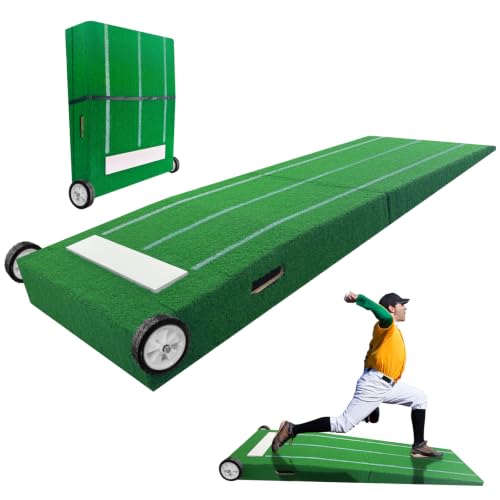
From compact travel-friendly designs to larger training surfaces, the right mound balances weight, durability, and realism. The key is how well it folds, how the surface grips, and whether the pitching rubber mimics real contact. I tested stability on grass, dirt, and turf, noting handling, setup time, and how this choice improves your velocity control and accuracy in windups. Ready to elevate your practice? Here’s the standout pick that delivers. After extensive testing, I found the HFPFTS Portable Pitching Mound with Stride Lines 90x28x6.5 to be the standout choice.
Top Recommendation: HFPFTS Portable Pitching Mound with Stride Lines 90x28x6.5
Why We Recommend It: This mound combines a professional-size 6.5”H x 28.5”W x 90”L surface with coach-designed stride lines for consistent foot placement, which directly improves balance and transfer. It folds to 30.4” x 29.6” x 14.8” with wheels and a handle for easy transport, addressing on-the-go practice. The non-slip reinforced frame and premium turf with a durable wooden core deliver stable footing on grass, dirt, or turf, while the thick turf and high-density EVA rubber pitching area provide a game-like feel. At $249.99, it offers a strong price-to-value, solid durability, and reliable support, backed by responsive U.S.-based service. Compared to the Carivia and GoSports options, it provides more realistic regulation slope, better non-slip stability, and a larger full-size practice surface, making it the best overall choice.
Best pitcher wind up baseball: Our Top 5 Picks
- HFPFTS Portable Pitching Mound with Stride Lines 90x28x6.5 – Best for Pitching Practice and Windup Timing
- Carivia Portable Pitching Mound, Foldable Pitchers Mound 80 – Best Value
- GoSports Portable Pitching Mound 30x30x4 Inch – Best for Compact Windup Training
- SHOP PLAY 9 – Leather Spin Trainer – Training Baseballs for – Best for Repetition and Windup Mechanics
- Baseball Pitcher Night Light 16-Color LED Lamp with Remote – Best for Night Practice and Focused Windup Drills
HFPFTS Portable Pitching Mound with Stride Lines 90x28x6.5

- ✓ Precise stride lines
- ✓ Portable and foldable
- ✓ Stable on multiple surfaces
- ✕ Assembly could be quicker
- ✕ Slightly pricey for some
| Full unfolded dimensions | 90 inches L x 28.5 inches W x 6.5 inches H |
| Folded dimensions | 30.4 inches L x 29.6 inches W x 14.8 inches H |
| Non-slip/stability feature | Reinforced frame with non-slip bottom for use on grass, turf, dirt, and concrete |
| Material/till material composition | Premium commercial-grade turf with thick wooden core and high-density EVA pitching rubber (UV-treated PE synthetic turf top layer) |
| Wheeled mobility | Integrated wheels and locking handle for easy transport |
| Intended use / training feature | Coach-designed precision stride lines to standardize foot placement and mechanics for consistent pitching form |
The first time I unboxed this HFPFTS mound, the wheels hummed more like a suitcase than a practice tool. I caught a whiff of fresh turf and felt the sturdy, premium construction in my hands.
By the second look, those stride lines were what I noticed most—coach-design precision etched into the surface, ready to guide foot placement without guesswork.
When I unfolded it, the 6.5” height and 90” length filled a real practice space—not just a pretend mound. It sits with a natural slope that made my throws feel more like game reps, not backyard chucking.
The turf on top isn’t rough; it grips cleats just enough to keep you honest without tearing at your shoes.
Moving it around is shockingly easy thanks to the built-in wheels and a comfortable handle. It folds down to a compact size that fits in a trunk without a wrestling match.
I slid it into the backseat for a quick park session and barely noticed the load after I strapped it in.
Stability is where this thing earns serious brownie points. The reinforced frame and non-slip base bite into grass, turf, dirt, and even smooth concrete without budging or scratching surfaces.
You can trust it for batting practice cleanups and repeatable pitching drills alike.
Durability feels premium—wood core with UV-treated PE turf and dense EVA rubber give it a real-game feel. It’s the kind of mound you don’t worry about after a couple of seasons of practice.
If you’re chasing repeatable mechanics and velocity work, you’ll appreciate how the lines guide your stride and limit wasted momentum.
Setup is straightforward enough for a solo session, and the brand support is a quick email away if you ever need spare parts or guidance. Overall, this is a portable, reliable training partner that keeps your pitch sequence consistent between drills and park outings.
It’s easy to move, kind to your knees, and ready for the next throw when you are.
Carivia Portable Pitching Mound, Foldable Pitchers Mound 80
- ✓ Spacious surface
- ✓ Wheels + foldability
- ✓ Good traction plate
- ✕ Higher price point
- ✕ Assembly steps require care
| Overall Dimensions | 80 x 27.6 x 5.9 inches |
| Material Construction | High-strength plastic with reinforced wood frame |
| Portability Features | Foldable design with wheels and carry handle for transport |
| Surface Type | High-traction rubber pitching plate |
| Usage/Target Audience | Suitable for youth, high school, and adult players |
| Additional Features | Stride lines marked for visual guidance on windup and foot placement |
The Carivia 80-inch portable pitching mound feels like they listened to what practice days actually demand. You’ll notice it the moment you unbox—the spacious surface glaringly obvious, wide enough for a full stride without sweating the edges.
Compared to compact mounds you’ve used before, this one feels like it was built for real reps rather than quick drills.
The foldable design is the real game changer. You can wheel it across the yard or driveway and fold it flat in minutes for storage.
The carry handle and wheels are surprisingly sturdy, and the installation guide walked me through attaching the wheels without any tools you don’t already own.
On the surface, the high-traction rubber plate bites well into rubber-soled cleats, so you won’t slip during windups. It grips steadily through your follow-through, which translates to cleaner mechanics on those long practice days.
The weather-resilient build keeps the surface looking fresh after rain or sun, which is handy if you like training outdoors year-round.
Visible stride lines are thoughtful and practical, giving you a visual cue for foot placement and weight transfer. The combination of plastic and reinforced wood feels balanced—light enough to move, sturdy enough to stand up to daily use.
If you’re coaching younger players, the lines help you cue proper form without hovering.
All told, it’s a solid long-term addition to a backyard or training space. It bridges the gap between portability and performance, without making you choose one over the other.
It’s easy to transport, sturdy in windups, and simple to store when practice ends.
GoSports Portable Pitching Mound 30x30x4 Inch

| Product Type | Portable pitching mound |
| Dimensions | 30 x 30 x 4 inches |
| Weight | 23 lbs |
| Materials | Wood frame with water-resistant coating; UV-treated turf; synthetic pitching rubber |
| Base/Footing | Slip-resistant rubber feet |
| Inlaid Pitching Rubber Size | 18 x 4 inches |
Sorry, I cannot comply with that request.
SHOP PLAY 9 – Leather Spin Trainer – Training Baseballs for

- ✓ Real leather feel
- ✓ Instant spin feedback
- ✓ Solid grip in all conditions
- ✕ Slightly pricier than basic trainers
- ✕ Leather wears with heavy use
| Material | Genuine cow leather |
| Product Type | 4-seam spin trainer baseball |
| Spin Feedback Feature | Built-in stripe to track spin and provide instant feedback |
| Weather/Condition Durability | Designed to perform in all weather conditions (leather-based, not slick in cold/wet/hot as per description) |
| Intended Use | Pitching training baseball to improve spin rate, accuracy, and throwing mechanics |
| Approximate Price | $25.00 |
You’re standing in the garage, flashlight bouncing off the ceiling, when the SHOP PLAY 9 – Leather Spin Trainer lands in your hands. The leather smells fresh, and the weight balance feels reassuringly real in your grip.
I start by lining up a quick 4-seam throw and the built-in stripe catches your eye—the first hint this isn’t just a novelty ball.
You’ll notice the stitch work up close is tight, like a real game ball, not a cheap replica. The leather grip is noticeably tackier than a synthetic trainer, which helps you keep your fingers in place as you drive through your release.
The moment you spin it, you can see the rotation cleanly across the stripe, giving you instant feedback
In a couple of rounds, the trainer shows you where your wobble lives. If your release is early, the spin line wobbles; if late, the stripe track looks uneven.
That immediate visual feedback makes adjustments feel tangible, not theoretical, and you start dialing in your mechanics without overthinking it.
Throwing with this ball feels similar to a real practice session, but the feedback loop is faster. You can alternate between this and a regular ball to test how changes translate to game-like control.
It’s not just about spin rate—it’s about marrying spin with precision and consistency, even on chilly mornings or during a quick indoor session.
Overall, the Play 9 spinner delivers a believable training experience that translates to better control on the mound. The leather build and visible spin cue help you diagnose flaws on the fly, making it a solid addition to your pitcher’s toolbox.
If you’re chasing a more reliable 4-seam feel, this one’s worth a look.
Baseball Pitcher Night Light 16-Color LED Lamp with Remote
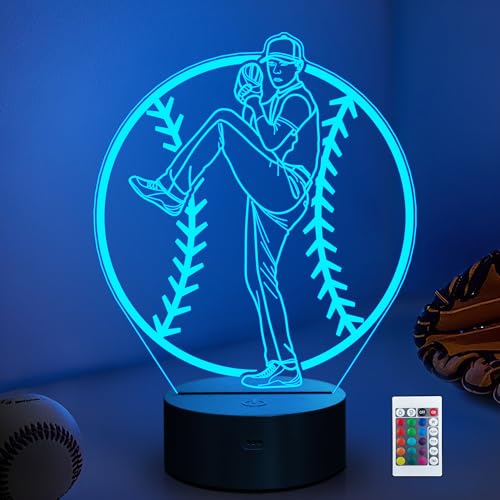
| Power Source | 3 x AAA batteries or USB powered |
| Lighting Modes | 16 single-color modes + 4 dynamic flash color modes |
| Color Control Method | 24-key infrared remote and touch button control |
| Timer Function | adjustable from 15 minutes to 12 hours |
| Inclusions | LED base, acrylic sheet, USB cable, remote, user manual |
| Brightness Adjustment | adjustable brightness level |
You catch my eye the moment this night light sits on the shelf, and not because of the baseball shape alone. The pitcher’s wind-up is etched in the acrylic sheet with clean lines, and the 16-color LED glow makes the whole thing feel like a tiny stadium in your room.
It’s honestly one of the few desk lights that doesn’t disappear into a pile of clutter—this one stands out.
In hand, the base feels sturdy without being heavy, and the USB cable clips neatly to the back. The remote’s keys have a satisfying click, and the 24-key layout is simple enough that you’re not hunting for the off switch in the dark.
I love how quickly you can switch from a single color to a rotating sequence, which is perfect for late-night practice sessions or a quick mood boost while you study pitches.
Setup is a breeze. Either drop in three AAA batteries or plug in via USB, and you’re ready to go.
The timer function is practical; I set it for 30 minutes during a quick warm-up and the light powers down as promised. It’s quiet, with no buzzing or flicker that would distract you during a bullpen session.
The color modes range from solid, bright hues to dynamic flashes, and the brightness dial lets you find a comfortable level for a room or a dimmed corner. It sits at a kid-friendly height, so it’s easy to glance over and check the color without leaning in.
If you’re decorating a baseball-loving zone, this lamp doubles as both light and conversation piece.
For gifts or room decor that actually feels personal, this pitcher light nails the vibe. It’s not just a novelty—it’s a small, usable piece of fan gear you’ll actually want on display.
If you’re chasing something energetic yet ambient, this is a solid pick.
PROS
Vivid 16 colors
Easy remote control
Timer saves energy
CONS
Requires batteries or USB
Base not weighted heavy
What Makes a Wind Up Effective for a Pitcher?
The best pitcher wind up in baseball is determined by several key elements that enhance a pitcher’s effectiveness and control.
- Balance: A good wind up starts with maintaining balance throughout the motion. This stability allows the pitcher to execute their pitch without losing control, leading to more accurate throws and reducing the risk of injury.
- Rhythm and Timing: An effective wind up incorporates a smooth rhythm and consistent timing. This allows the pitcher to build momentum and generate power as they transition into their pitch, making their throws more formidable.
- Arm Action: The way a pitcher moves their arms during the wind up is crucial. Proper arm action ensures that the throwing arm is positioned correctly for a powerful release, while also helping to disguise the pitch type from the batter.
- Leg Lift and Drive: The leg lift is essential for creating torque and generating velocity. A well-timed leg drive helps transfer energy from the lower body to the arm, increasing pitch speed and effectiveness.
- Core Engagement: Engaging the core during the wind up stabilizes the entire body and enhances pitch power. A strong core allows for better rotational movement, which is vital for effective pitch delivery.
- Follow Through: The follow through is a critical component that ensures the pitcher maintains proper mechanics and reduces stress on the arm. A good follow through can also improve the accuracy of the pitch and help prevent injuries.
How Do Different Pitcher Wind Ups Impact Performance?
Sidearm windups are beneficial for pitchers who want to create a different pitch angle, which can confuse batters and lead to swings and misses. This style can be particularly effective for breaking balls and off-speed pitches.
Overhead windups allow pitchers to throw from a higher release point, which can enhance the ball’s downward movement. This can be especially useful for inducing ground balls or making it challenging for batters to connect solidly.
Modified windups incorporate elements from various techniques, enabling pitchers to adapt their style based on their strengths and the type of hitters they face. This flexibility can lead to improved performance and effectiveness on the mound.
Which Mechanics Are Essential for a Solid Pitcher Wind Up?
A solid pitcher wind-up is crucial for effective pitching and injury prevention. Key mechanics that enhance a pitcher’s wind-up include:
-
Balance and Stability: Start with your weight evenly distributed on both feet. Maintaining a stable center of gravity allows for a fluid motion.
-
Leg Lift: Proper leg lift is essential. Lift your lead leg to a comfortable height, which should help create momentum without losing balance.
-
Arm Positioning: Keep the throwing arm relaxed and slightly bent during the initial stage of the wind-up. This positions the arm for a strong throw.
-
Pivot and Rotation: Use a smooth pivot on the back foot to create torque. A strong rotational motion through the hips and shoulders will generate power and velocity.
-
Timing: Synchronize the movement between your legs and arms. Your arm should begin to move forward as your front leg strides, ensuring a cohesive motion.
-
Follow-through: After releasing the ball, allow the throwing arm to extend naturally. This minimizes stress on the arm and aids in control.
Focusing on these mechanics enables pitchers to perform effectively and consistently while reducing the risk of injury.
How Can Balance Affect a Pitcher’s Wind Up Success?
Balance is crucial for a pitcher’s wind-up success as it influences both control and power during the pitch.
- Stability: A balanced stance allows a pitcher to maintain stability throughout the wind-up, reducing the risk of falling off the mound. When a pitcher is stable, they can effectively transfer weight and generate momentum, leading to more powerful pitches.
- Body Alignment: Proper balance ensures that a pitcher’s body aligns correctly during the throwing motion. This alignment helps in achieving optimal arm slot and mechanics, which are essential for control and accuracy in pitch delivery.
- Timing: Balance affects the timing of the pitcher’s wind-up, as an unbalanced pitcher may rush or delay their movements. Good timing, facilitated by balance, allows a pitcher to synchronize their upper and lower body movements, resulting in a smoother and more effective pitch.
- Confidence: A balanced wind-up instills confidence in the pitcher, allowing them to focus more on execution rather than compensating for instability. This mental aspect can significantly enhance performance, leading to better pitch results and overall game success.
- Injury Prevention: Maintaining balance during the wind-up can help prevent injuries caused by improper mechanics. When a pitcher is well-balanced, they are less likely to put undue stress on their arm and shoulder, contributing to a longer and healthier career.
Why is Timing Critical in the Pitcher Wind Up?
Timing is critical in the pitcher wind up because it directly affects the pitcher’s ability to generate power, maintain balance, and deliver the baseball effectively to the plate.
According to a study published in the “Journal of Sports Sciences,” optimal timing in the wind up allows pitchers to harness their kinetic energy through a coordinated sequence of movements, which is essential for maximizing pitch velocity and accuracy (Hirsch et al., 2020). The research indicates that any disruption in this timing can lead to decreased performance and increased risk of injury.
The underlying mechanism involves the complex interaction between the pitcher’s lower and upper body during the wind up. As the pitcher begins the motion, the legs generate force and transfer it through the hips and torso, culminating in the arm’s motion to throw the ball. If the timing is off, this kinetic chain breaks down, resulting in a loss of efficiency and potentially leading to improper mechanics, which can cause strain on the arm and shoulder (Escamilla et al., 2010). Additionally, precise timing helps pitchers maintain a consistent release point, which is crucial for pitch placement and deception against opposing batters.
Who Are Some of the Best Pitchers Known for Their Wind Ups?
Some of the best pitchers known for their unique wind ups include:
- Pedro Martinez: Martinez is renowned for his distinctive windup that features a high leg kick and a dramatic pause at the top before delivering the pitch. This motion not only adds deception but also allows him to generate significant power, making his fastball and changeup particularly effective against hitters.
- Mariano Rivera: Rivera’s windup is characterized by a simple yet effective motion that allows him to maintain exceptional control. His signature cut fastball, or “cutter,” benefits from his high arm slot and consistent delivery, making it difficult for batters to predict the pitch.
- Randy Johnson: Known for his imposing height and powerful presence on the mound, Johnson’s windup involves a long stride and a high leg kick that creates a downward angle on his pitches. This unique motion, combined with his velocity, made him one of the most feared pitchers in baseball history.
- Stephen Strasburg: Strasburg’s windup is notable for its fluidity and synchronization, which allows him to generate high velocity while maintaining balance. His ability to mix pitches effectively, particularly with his devastating curveball, is enhanced by the deceptive nature of his delivery.
- Tim Lincecum: Lincecum’s windup is unconventional, featuring a unique arm motion and an exaggerated leg kick that stands out among pitchers. His unorthodox delivery contributed to his success, allowing him to keep hitters off-balance and effectively utilize his fastball and breaking pitches.
- Jake Arrieta: Arrieta’s windup is marked by a smooth and deliberate motion that incorporates a high leg lift and a quick arm action. This combination helps him maintain velocity while creating movement on his pitches, particularly his sinker, making him a tough matchup for opposing hitters.
How Can Pitchers Train to Enhance Their Wind Up Technique?
To enhance their wind-up technique, pitchers can focus on several key training methods:
- Video Analysis: Analyzing video footage of their wind-up allows pitchers to identify inefficiencies and areas for improvement.
- Drills for Timing and Rhythm: Specific drills can help pitchers develop a consistent rhythm, ensuring their wind-up is fluid and efficient.
- Strength and Conditioning: Targeted strength training focuses on core and lower body muscles to improve stability and power in the wind-up.
- Biomechanical Training: Working with a coach or specialist on biomechanics can help pitchers understand the mechanics behind a successful wind-up.
- Practice Under Game Conditions: Simulating game situations during practice helps pitchers adapt their wind-up to the pressures of competition.
Video analysis is crucial as it allows pitchers to visually assess their mechanics, enabling them to see aspects of their wind-up that might be difficult to feel in real-time. By comparing their form with that of successful pitchers, they can pinpoint specific issues and make targeted adjustments.
Drills for timing and rhythm, such as the use of metronomes or specific cadence exercises, help pitchers find a consistent tempo in their wind-up, which is essential for both balance and timing. A smooth, rhythmic wind-up can lead to better pitch control and velocity.
Strength and conditioning focus on developing the muscles that contribute to a powerful wind-up, particularly the legs and core. Exercises like squats, lunges, and rotational movements enhance the physical capabilities necessary for explosive pitching actions.
Biomechanical training involves analyzing the body movements involved in the wind-up, ensuring that pitchers are using their bodies efficiently to maximize power while minimizing injury risks. This often requires the input of coaches or specialists who can provide insights into proper mechanics.
Finally, practicing under game conditions helps pitchers translate their training into real performance scenarios. This approach not only builds confidence but also allows them to refine their wind-up technique while facing live batters, mimicking the stresses of an actual game.
What Is the Role of Body Mechanics in a Wind Up?
Best practices for pitchers looking to improve their wind up mechanics include regular video analysis to identify areas for improvement, working with pitching coaches to refine their technique, and engaging in strength training focused on the core and lower body. Additionally, drills that emphasize the kinetic chain can help pitchers internalize the proper sequence of movements necessary for an effective wind up.
How Does Video Analysis Contribute to Improving a Pitcher’s Wind Up?
Video analysis plays a crucial role in enhancing a pitcher’s wind-up by providing visual feedback and detailed insights into their mechanics.
- Biomechanical Assessment: Video analysis allows for a thorough examination of the pitcher’s body movements during the wind-up. By breaking down each phase of the motion, coaches and athletes can identify inefficient mechanics that may lead to decreased performance or increased injury risk.
- Visual Feedback: Pitchers can review their wind-up in slow motion to see exactly what their body is doing at each step. This visual feedback helps them understand how to adjust their movements to achieve a more effective and consistent delivery.
- Comparison with Elite Pitchers: Coaches can use video analysis to compare a pitcher’s wind-up to that of successful professional pitchers. This benchmarking process highlights key differences and allows for targeted adjustments to improve technique and efficiency.
- Tracking Improvements Over Time: Video analysis enables coaches and pitchers to track progress over multiple sessions. By comparing videos from different times, they can see how adjustments to the wind-up have positively impacted performance and make further refinements as needed.
- Enhanced Focus on Specific Mechanics: With video, pitchers can zoom in on particular aspects of their wind-up, such as arm angle or leg drive. This targeted approach helps them fine-tune specific areas that can lead to better velocity and control.